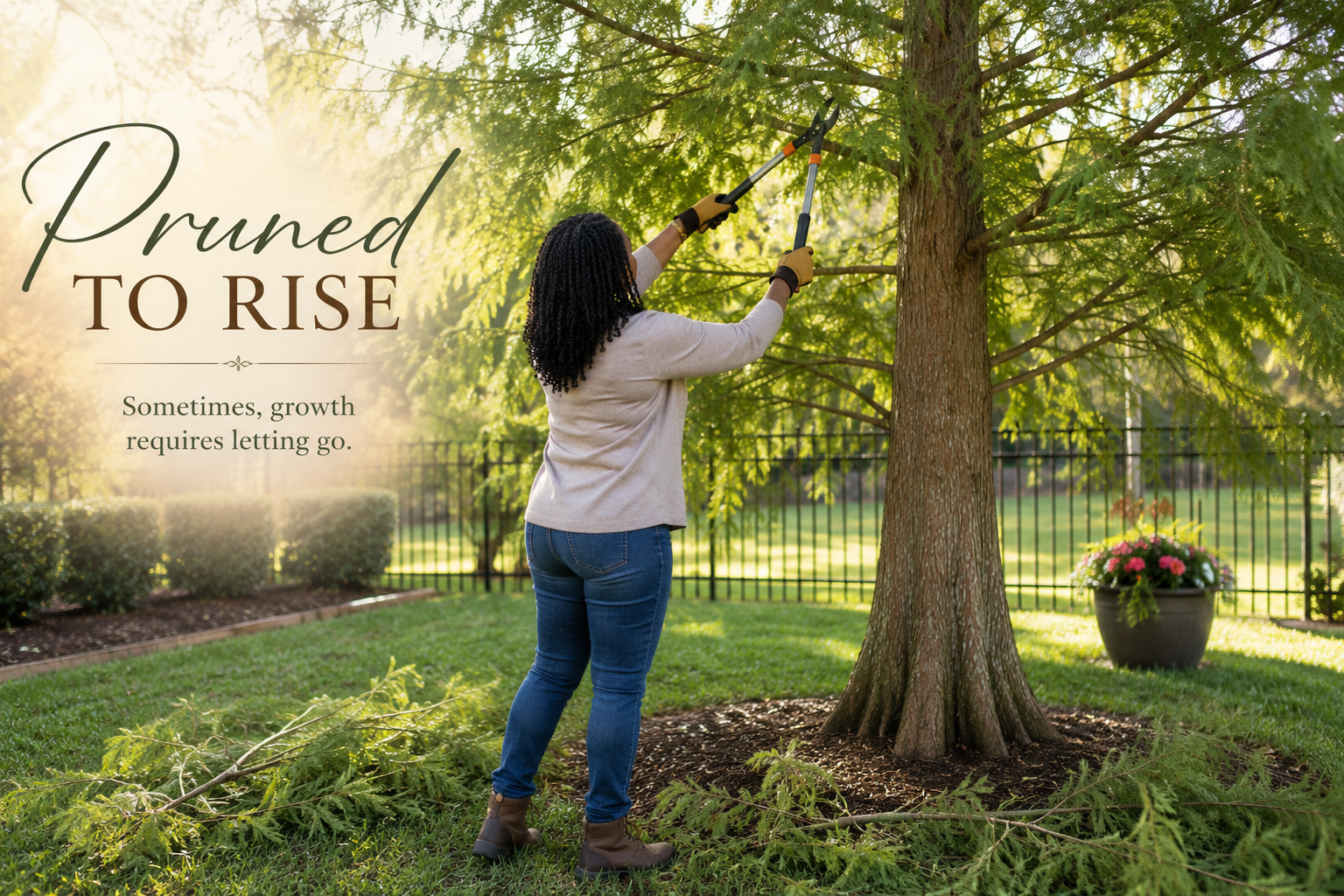

Pruning to rise, or for growth, isn’t something most of us ask for. Though we celebrate growth, promotion, and increase, few of us welcome the process of being pruned. Yet some of the greatest seasons of growth begin with cutting away what is no longer needed or helpful.
Context:

Neighbors often compliment us on the bald cypress tree growing in our front yard. This tree has grown impressively tall and full over the years, providing just the shade we hoped for. In fact, it frames the front of our house beautifully, and each year it continues to thrive and outgrow the once matching cypress on the other side of the driveway. This year has been no different.
Actually, by spring and early summer, the tree had grown so much that some of its branches were beginning to stretch across the sidewalk, reach toward the house, and extend into the driveway. Though we were amazed by its growth, it had simply become more than the space in our front yard was designed to hold.
So, I offered to Leon,
“Do you think we can go ahead and prune that tree again?”
Let’s just say. . . . my husband wasn’t exactly excited about taking on this project—especially on a Sunday afternoon.
But . . . he agreed.
Pruning for Growth Begins with Intention
Before we began cutting, Leon did some research for us. We wanted to ensure we pruned the tree correctly so we wouldn’t damage it in any way, or cut it in a way that would be unbecoming or take away from the curb appeal of our home. We wanted to be strategic and intentional, because our goal wasn’t just to make the tree smaller, but to preserve its natural posture.
Once we determined which limbs and branches we would need to cut, we also thought we might need a better saw. So, we headed out to the popular hardware stores to make sure we had the right tool for the job.
When we returned home, we once again identified which areas of the tree we wanted to trim. After making a few cuts, we’d step back, make further assessments, and then cut again.
On the lower portion of the tree, we removed entire limbs to give the tree a proper base to expose the root flare and give the trunk room to breathe. This is also known as “raising its skirt.” I have learned this term “raising the skirt” is more than just sassy terminology. It serves a much greater purpose. “Raising the skirt” isn’t just about how a tree looks; it’s about protecting its health, strengthening its growth, and creating the conditions for everything beneath and around the tree to thrive.
Not Every Branch Should Remain

When a tree has limbs growing near the root flare (where the trunk naturally widens and transitions into the roots), the roots must send nutrients and energy to support those lower limbs, taking away resources from the upper canopy. This can limit the tree’s ability to reach its full height. Pruning those lower limbs redirects that energy upward while allowing grass and plants beneath the tree to receive needed sunlight. It also improves airflow around the trunk, reducing excess moisture that can contribute to the light green fungus we sometimes see on trees.
Then, what I also found enlightening was that pruning lower-growing limbs growing near driveways and streets is also beneficial for overall safety and accessibility. By opening the space, it creates better visibility and access for drivers and walkers, and removes potentially dangerous blind spots.
NOW THAT’LL PREACH ALL BY ITSELF!
As Leon and I continued our pruning journey, once the lower branches were removed and we accomplished the height we wanted for clearance, it was time to trim some of the outlying branches from the upper canopy. Not cut them completely. . . just make them shorter.
Then something happened that I wasn’t expecting.
Growth Without Stewardship Can Become a Burden
When we trimmed the longer branches. . . what we noticed is that they didn’t just become shorter. The remaining branch seemed to quickly ascend, almost as though a spring had been released.
Right before our eyes, limbs that had apparently been weighed down by branches whose growth and length had become excessively heavy began curving upward.
Yes. The tree began taking on a better, more defined shape.
Literally.
It appeared more balanced. Appeared to stand taller.
No. The cuts we made didn’t at all taken away the tree’s beauty or identity.
They revealed it.
Let’s ponder on that . . .
When We Mistake Growth for Purpose
How often do we resist having something taken away from us because we’re afraid of what we’ll lose?
In our human experience, we often despise pruning.
We assume that if something is taken away, we’ll somehow become LESS.
Less successful . . . less admired . . . less influential . . . less valuable.
But what if we’ve been looking at it from the wrong perspective?
What if the issue isn’t what we’re losing . . . but what we’re holding on to that’s weighing us down or keeping us from our true identity?
Sometimes we become so focused on growth that we forget to ask whether that growth is still aligned with our purpose. Just because something is growing doesn’t automatically mean it’s growing in the right direction. Over time, what we once celebrated as healthy growth can become the very thing that creates unnecessary stress, limits our visibility, and even causes harm to ourselves and those we care about.
Still, we tend to keep reaching for more. More opportunities. Responsibilities. Accomplishments. Possessions.
Somewhere along the way, it’s easy to mistake having more to do for having more purpose. But purpose isn’t measured by how much we can accumulate or how busy we become. It’s revealed by how faithfully we steward what God has entrusted to us.
Yes, growth is a blessing, but unmanaged growth can begin to pull us in directions we were never intended to go and cause us to bear weight we were never intended to carry.
Looking back, I know the goal was never to stop the tree from growing.
Why would we? Growth is a beautiful thing. But, we still have to apply reasoning.
By pruning the tree, we were helping it stay aligned with the purpose for which it was planted.
With that thought in mind, I couldn’t help but wonder how often God is doing the very same thing in our lives—not trying to stop our growth, but redirecting it so it remains aligned with the purpose for which He created us.
That’s another realization I had to sit with.
Sometimes God Prunes What Is Already Fruitful
How often have I said “yes” because something seemed good in the moment, while failing to ask not only whether it was still right for the current season, but whether it would benefit the seasons to follow?
How many branches in my life have I allowed to keep stretching simply because I was excited to see growth?
Well . . . here’s something else I learned. Healthy trees require more than care during their growing season. They require preparation for the seasons that are coming. That preparation helps them withstand the harsher conditions that await without sacrificing the health they’ve worked to cultivate in the prior season.
The same is true for us.
God doesn’t grow us only for where we are in the moment. He also prepares us for where He’s calling us in the next season. Sometimes, that preparation looks and feels a lot like pruning.
Not Everyone Sees the Pruning
That Sunday afternoon, I thought all my husband and I would be doing was trimming a tree. Instead, I walked away with reminders that extended far beyond the tree itself.
Now, if there is one thing I’ve learned about that bald cypress in my front yard it is this:
The growth isn’t finished. Neither is the need for pruning.
Next year, Leon and I will be at it again.
Because as long as we’ve lived in our home, that tree has continued to thrive and beg our attention.
And there lies another lesson.
Growth doesn’t eliminate the need for stewardship. If anything, it increases it.
And, while our neighbors will probably continue to compliment our tree . . . they won’t always witness the pruning.
They won’t see the time we spend planning, the decisions behind every cut, or the intentionality required to determine which branches should remain in order to shape, strengthen, and support the tree’s continued growth and purpose.
That’s also true of life.
People will naturally notice what we have or what we’ve accomplished,
but they won’t always see what we had to lose, release, or deny ourselves of
in order to stand as tall as we do, or just to be able to stand at all.
Pruned to Bear More Fruit

Jesus said,
“I am the real vine, and my Father is the gardener. 2 He [cuts] off every branch in me that does not bear fruit, and he prunes every branch that does bear fruit, so that it will be clean and bear more fruit. (John 15:1-2, NKJV)
Notice Jesus wasn’t talking about dead branches. He was talking about fruitful ones.
It would seem easier or even justifiable to let go of something that’s already dead or no longer serving us. But, the real challenge comes when God asks us to release something that still appears fruitful, productive, or looks like it’s working well.
You may have noticed the scripture explains that pruning is a process of “cleaning.” Had you ever realized that seasons of growth also have a tendancy to leave behind residue? (Both hands up and looking away.) I’ll save that for a different blog.
If in this season you feel as though things are being cut . . . Don’t despise the pruning. Know that God isn’t trying to diminish you. But more than likely, He’s preparing you for a season you don’t yet see.
Don’t be afraid of what or who you’ll lose. Sometimes the very thing God removes is what creates room for the fresh fruit He’s preparing for you to bear. So, what feels like pruning today could be the very thing that allows you to stand taller, see more clearly, and bear greater fruit in the season ahead.
Trust your Gardener.
Take it from me . . . He knows exactly where to cut. ~Dawn
“I am the vine, and you are the branches. Those who remain in me, and I in them, will bear much fruit; for you can do nothing without me. 6 Those who do not remain in me are thrown out like a branch and dry up; such branches are gathered up and thrown into the fire, where they are burned. 7 If you remain in me and my words remain in you, then you will ask for anything you wish, and you shall have it. ~John 15:5-7 GNT
Continue the Journey
Hey Friend! Has God ever used an ordinary moment to teach you an extraordinary lesson?
I’d love to hear about it in the COMMENTS, or learn how this message resonated with you.
Maybe you know someone who is walking through a season of pruning. Share this reflection with them. Let’s pray that they will find encouragement while they wait for evidence of the fruit.
And if you enjoy finding God’s lessons in everyday life, you may also enjoy reading:
Let’s continue growing together.
For more like this, SUBSCRIBE here and join the Dawn of a New Day 365 community on Facebook and Instagram. We’d love to have you.
Always here to bring a little SUNSHINE!
~Dawn

Click the photo below for another purposeful perspective. 💛

Discover more from Dawn of a New Day 365
Subscribe to get the latest posts sent to your email.